Education and Support for Orphaned Students Worldwide
Education and Support for Orphaned Students Worldwide
Donate to
Support Students
Newsletter
Join our email newsletter
Stay up to date with all activities and opportunities.
We use cookies on our website to personalize and improve your experience and improve.
By continuing, you agree to the terms of our Privacy Policy.
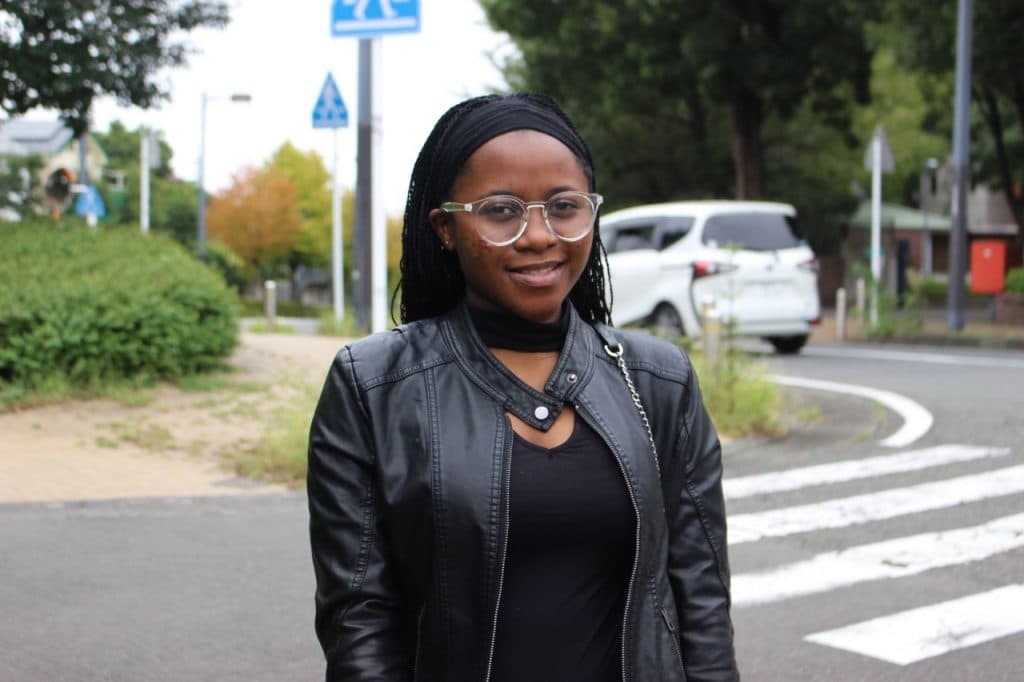
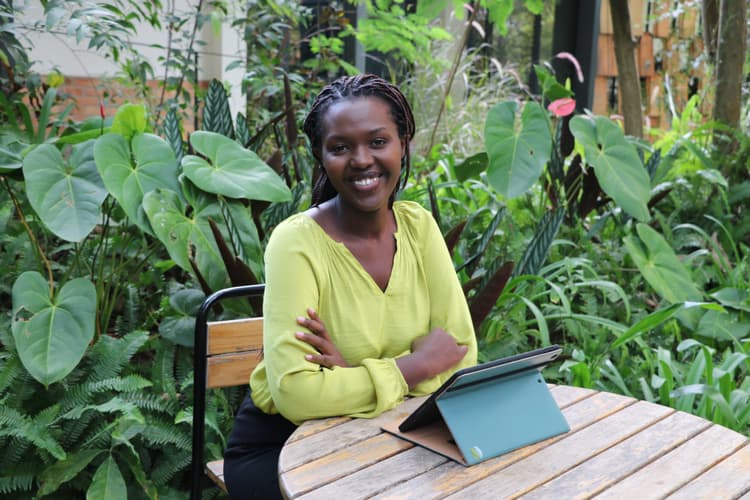
Callis, a graduate of the Ashinaga Africa Initiative (AAI) and Keio University, spent her undergraduate years in Japan studying under the faculty of Environment and Information Studies with a focus on Agricultural Development. Throughout her university years, she grew a deeper understanding of purpose rooted in connection, cultural exchange, and a vision for Africa’s agricultural future.
Growing up in Bamenda, a town in Cameroon’s Northwest Region, Callis spent the foundational years of her life with her aunt and family after her parents’ passing. Despite financial constraints, Callis found warmth in the family and took initiative to support herself, turning her handmade creations into a small business.
But Callis’s learning journey was shaped by far more than limited resources; it unfolded during deep political instability in Cameroon. Around 2015–2016, a crisis erupted between the English-speaking regions of the Northwest and Southwest and the French-speaking central government. As the situation deteriorated, insecurity spread across many English-speaking regions, disrupting daily life and severely affecting access to education. Schools were frequently closed, and for many students, simply traveling to and from class became unsafe. “It became extremely dangerous to go to school,” Callis recalls. During her high school years, she and her classmates stopped wearing uniforms and took precautions to avoid drawing attention, sitting for both her O Level and A Level national exams in an atmosphere of constant uncertainty. Despite these risks, Callis remained determined to learn, driven by a long-held goal to combine agriculture and business to create meaningful change in her community.
Despite the political turmoil, Callis completed her national exams and later joined Open Dreams, the organization that supported her application to Ashinaga. Through its mentorship and community network, she was introduced to opportunities, including the Ashinaga Africa Initiative (AAI). Her perseverance paid off when she was accepted into Ashinaga, completing the preparatory program remotely during the COVID-19 pandemic.
Callis finally came to Japan after finishing her first semester online, but faced challenges concerning adaptation and communication. Adapting to life in Japan proved challenging for Callis. “At first, I struggled with the language and the culture,” she recalls. But by finding support from her friends, academic mentors, and classmates, Callis began to find her place at the university and in Japan. Her stories of struggling to adapt to a new country with a completely new language reflect how she did not let adversity get the best of her. “There were days when I questioned if I could really fit in. But those experiences forced me to grow stronger.”
While pursuing her degree at Keio University, Callis sought experiences that would take her beyond the classroom. She found one that would transform her perspective: a community farm in Fujisawa, where she volunteered regularly alongside Japanese locals. Her openness to new experiences and adaptability in a new environment helped her shape her kokorozashi, a personal life goal focused on contributing to society. “I would like to call myself a representative of the African continent in that community,” she says. “Before I joined, most of them had never interacted with an African before.” Meeting me gave them a new perspective on Africa that we’re people with dreams, warmth, and so much to contribute.” At the farm, Callis helped cultivate vegetables, visited local schools, and worked with children, moments she recalls fondly. “We would plant potatoes with the nursery and elementary school kids,” she says. “For those children, that might have been their first encounter with someone from Africa. Experiences like that can change how they see the world.” The farm became more than a volunteering opportunity; it became a bridge between cultures. “Working with the farmers and the kids taught me patience, openness, and empathy,” she explains. “I didn’t feel like an outsider. I felt part of something, like we were all learning from each other.” The moments she shared with people from the farm and schools deepened her understanding of the culture and value of the shared community in Japan.
That sense of responsibility carried over into her work with Providence Action, an organization she co-founded in Cameroon. The group supports children’s education in conflict-affected areas, helping them access schools and essential resources. “When I started, I was so passionate,” she says. “But later, I realized I wasn’t as consistent as I could be. After my experience in Japan, I changed my approach. I became more present, more deliberate, and the results showed. We went from supporting 13 students to 25 in one year.” Callis sees Providence Action not just as a charity, but as a platform for empowerment. “It’s about giving young people hope but also showing them that we can lead our own change,” she explains. Callis aims to support aspiring students from her home country who face challenges similar to those she once faced, empowering future leaders through access to education. In doing so, she embodies Ashinaga’s spirit of paying it forward- extending the support she once received to underprivileged youth in Cameroon.
Through her studies and experiences, Callis refined her kokorozashi, her life’s mission to empower young Africans in agriculture. “I want to help young people build agricultural businesses that grow beyond small-scale ventures,” she says. “Africa has so much potential. With our land, our youth, and our creativity, we can contribute to the world if we approach it strategically. “Her years in Japan showed her what effective agricultural management and strong community systems could look like. Beyond technical skills, she learned the value of collaboration and shared purpose in transforming the way agriculture can impact society. “In Japan, I saw how organized everything is,” she says. “I want to bring that spirit of structure and collaboration back home and also build partnerships between Japan and Africa.” Her long-term goal is to establish an agricultural ecosystem in Cameroon, one that connects production, business, and education. “I want to create something like the Fujisawa farm back home,” she says. “A place where people can learn from each other, where Japanese farmers can visit Africa and see how we grow food, and Africans can learn about sustainable systems from Japan.”
After graduating from Keio University, Callis began working part-time at Tokyo Global Gateway, where she teaches English to Japanese students through interactive simulations. “Every day I meet different kids, and I help them communicate in English in different scenarios,” she says. “It’s fun, but it also reminds me how learning new skills can open worlds for people.” At the same time, she is preparing for graduate school, aiming to specialize in sustainable agriculture and agribusiness. “Before starting my own initiative, I want to gain real work experience in agricultural development,” she says. “Then, I’ll go back home to build something that connects Africa to the world, starting with Japan.”
As she applies to pursue graduate studies in Sustainable Agriculture and Agribusiness, Callis envisions the next phase of her journey as an opportunity to deepen her expertise and expand her network of collaborators. Her long-term goal remains clear: to build an agricultural ecosystem in Cameroon that connects African and Japanese innovation through shared learning and sustainable practice. “I’m excited for what comes next,” she says. “Graduate school will be another chance to learn, to experiment, and to grow. Everything I’ve experienced so far, from the farm in Fujisawa to my work at the university, has prepared me for this next step. It’s all part of the journey toward creating something meaningful, something that grows beyond me.” Grounded in empathy and driven by vision, Callis continues to cultivate connection wherever she plants her roots. Throughout her journey, Callis embodies the essence of Ashinaga’s mission to nurture compassionate leaders who turn adversity into opportunity.
Recommended Tags
Related Articles
In Commemoration of International Day of Education : Callis’s Journey and Her Commitment to Giving Back
Recommended Articles
Empowering Africa’s Future Leaders: Ashinaga at TICAD 9